Your shopping cart is currently empty.
| Subtotal | €0,00 |
| Shipping costs | including VAT, excl. Shipping costs |
| Total | €0,00 |
|---|


23.11.2025
Urban trees are among our cities' most important allies in the face of climate change: they provide shade, cool their surroundings, and help maintain the quality of life on hot summer days. Furthermore, trees and green spaces can retain rainwater, thus helping to mitigate the effects of heavy rainfall.
At the same time, the trees themselves are suffering from the effects of climate change. Rising temperatures, longer periods of drought, and altered rainfall patterns are hitting urban trees in locations where living conditions are already difficult.
This creates a dilemma: because our cities are getting warmer, we need healthy and large trees. But at the same time, it is becoming more difficult for many urban trees to grow old healthily.
Table of Contents
- Why climate change is particularly affecting urban trees
- Heat puts city trees under stress
- Drought is becoming a problem for city trees
- Diseases and pests can create additional pressure.
- Urban trees are also part of the solution.
- Which urban trees can cope with climate change?
- How can cities adapt their trees to climate change?
- What can we do ourselves for city trees?
Why climate change is particularly affecting urban trees
Trees can generally adapt to different environmental conditions. The problem, however, lies in the speed and combination of these changes. Heat waves and prolonged periods of drought pose particular challenges for trees. The German Federal Environment Agency assumes that urban vegetation will come under increasing pressure from the combination of drought, heat, diseases, pests, and storms.
Urban trees also face the additional challenge of already growing under difficult conditions: sealed surfaces limit rainwater absorption, soils can be compacted, and the available root space is often small and perhaps even interrupted by pipes and cables. Climate change is exacerbating these stresses in many places, stresses that trees already have to cope with.
You can find more information about these special site conditions in our article. Increasing problems for city trees.
Heat puts city trees under stress
Heat poses a particular challenge in cities because buildings, streets, and other sealed surfaces absorb solar energy during the day and release the stored heat later. At the same time, there is often less vegetation and evaporation than in the surrounding countryside. This creates the so-called urban heat island effect: cities can be significantly warmer than their surrounding areas, especially at night.
For urban trees, this means they are sometimes exposed to extreme temperatures during heat waves. Studies by the Bavarian State Research Center for Viticulture and Horticulture (LWG) show just how severe these stresses can become. The research project Urban Greenery 2021+ During heat waves, temperatures were measured from the root zone to the tree canopy. Depending on the location and mulch material, temperatures exceeding 60 °C were measured in the upper soil layers. Bark and leaves can also heat up considerably.
Such extreme values cannot be generalized to every urban tree. However, they illustrate the conditions to which trees in intensely heated locations can be exposed.
Drought is becoming a problem for city trees
Trees face particular challenges when high temperatures coincide with prolonged periods without sufficient rainfall. They release water into the environment through their leaves, a process known as transpiration. High temperatures increase their water requirements. If there isn't enough plant-available water in the soil, the tree may... Drought stress devices.
Trees react to this, among other things, by closing their stomata and thereby reducing water loss. If the water shortage persists, growth and photosynthesis This may be restricted. Depending on the tree species, location, and severity of the drought stress, leaves may wilt, dry out, or be shed prematurely.
The situation can be particularly critical for young urban trees. Their root system is not yet fully developed and therefore has less soil space to access.
Diseases and pests can create additional pressure.
Climate change can also alter the relationships between trees, pathogens, and pests. However, there is no simple rule like "more heat automatically means more pests." Species react differently to changing temperatures. At the same time, new species can migrate into the area or spread more widely under altered climatic conditions.
The condition of the tree itself is also crucial. A tree that has already suffered from prolonged heat and water scarcity may be less resistant to additional stresses.
Urban trees are also part of the solution.
Climate change is putting a strain on urban trees, yet we need them to adapt our cities to climate change. Trees shade streets, buildings, and squares. At the same time, they transpire water, drawing heat from their surroundings. This allows them to improve the microclimate and reduce heat stress in their immediate vicinity.
In addition, they provide other benefits: urban trees offer habitats for animals, store carbon, can retain air pollutants and contribute significantly to the quality of life in cities.
You can find out more about these connections in our article. Trees and the urban microclimate.
Large, old, and healthy trees are particularly valuable. A newly planted sapling cannot directly replace the benefits of a tree that is decades old. Therefore, adapting to climate change involves not only planting new trees, but above all, protecting existing trees.
Which urban trees can cope with climate change?
Which tree species is suitable for a given location depends on factors such as climate, soil, available root space, water supply, frost, heat, and other site conditions. Therefore, in Germany, research has been conducted for many years to determine which tree species have a good chance of survival under future conditions.
In the aforementioned research project Urban Greenery 2021+ The Bavarian State Institute for Viticulture and Horticulture, for example, is investigating various tree species at climatically different locations. This reveals significant differences in the heat and drought tolerance of various species.
However, the results also show why the term "climate tree" should be used with caution: A tree that copes well with heat and drought is not automatically suitable for every location.
In addition to choosing suitable species, diversity is also important. A city tree population consisting of many different species can reduce the risk of diseases, pests, or specific climatic conditions affecting a large proportion of the trees simultaneously.
You can find out which species are being discussed and studied as potential urban trees of the future in our article. City trees of the future.
How can cities adapt their trees to climate change?
Selecting suitable tree species is only part of the solution. Good locations are at least as important. Even a relatively drought-tolerant tree can experience long-term difficulties if it has access to poorly penetrable soil or if rainwater is completely drained away.
Climate-adapted urban tree development therefore includes, for example:
- Sufficiently large and well-rooted tree sites
- Water-retaining and at the same time well-ventilated soils
- Protection against soil compaction
- Minimal sealing of surfaces in the vicinity of the trees
- Use and storage of rainwater
- a diverse and site-appropriate selection of tree species
- long-term care and sufficient watering, especially during the growth phase
What can we do ourselves for city trees?
Climate adaptation is primarily a long-term task for urban planning and urban green space management. Nevertheless, citizens can also make a contribution.
For example, in many cities there are Tree or watering sponsorshipsIn this initiative, people take care of one or more trees in their neighborhood and support them, especially during dry summers.
Young trees, in particular, may require additional watering during prolonged dry periods. It's advisable not to water them with small amounts daily, but rather to water them more frequently and thoroughly. The water should be able to penetrate the soil slowly, instead of running off the surface.
How much water is appropriate and what you should pay attention to when watering is explained in detail in our guide. Water trees properly.
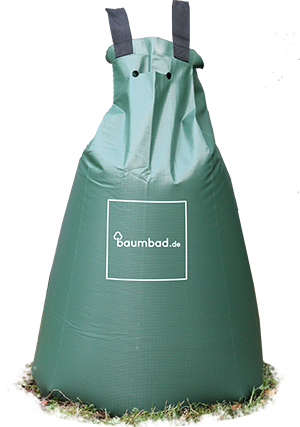
One way to achieve slow water release is Irrigation bagsThey are placed around the trunk and release the water they contain into the soil over a longer period. They can make watering easier, especially for young trees.
Do you want more tree knowledge?
That might interest you

Edible trees in the city: How to grow them...
Edible trees can make our cities greener, more diverse, and more livable. They provide fruit...

Tree suffers after construction work: What to do...
After garden renovations or construction work, trees suddenly show signs of decline. Often, the cause is...
Great idea, easy handling and everything from ordering to delivery.
Michael K.