Your shopping cart is currently empty.
| Subtotal | €0,00 |
| Shipping costs | including VAT, excl. Shipping costs |
| Total | €0,00 |
|---|


15.08.2026
Trees have one positive influence on our health, regulate the urban microclimate and provide a habitat for numerous animals. Trees are therefore particularly valuable in densely populated cities.
At the same time, cities are challenging habitats for trees. Street trees, in particular, often grow under conditions that bear little resemblance to an ideal ecosystem: root space is limited, soils are compacted, large areas are sealed, and water has restricted access to the roots. Added to this are heat, road salt, pollutants, and damage from traffic or construction work.
The basis for this post is an excellent article, which was published by the University of Hamburg in cooperation with the Federal Office for the Environment.
Why urban trees grow under difficult conditions
A tree needs more than just sufficient space above ground for its crown. The space below ground is equally important, as this is where the roots absorb water and nutrients. Good soil should therefore be able to retain water while simultaneously containing enough pores to allow air and water to reach the root zone. Unfortunately, this is often lacking in urban areas.
The Bavarian State Research Institute for Viticulture and Horticulture (LWG) It describes urban trees as often growing in isolation and exposed locations, which have to cope with a variety of unfavorable site conditions. These include, among other things, limited root space, soil compaction, pollution, and the specific climatic conditions of the city.
Limited root space
Besides sidewalks and roads, tree roots compete for space with pipes, canals, foundations, and other underground infrastructure. Street trees, in particular, are often planted in small tree pits surrounded by asphalt. This limits the soil space a tree can access with its roots, and therefore also the space from which it can draw water and nutrients.
soil compaction
Another problem is compacted soilsThey can be caused, for example, by construction work, vehicles, or intensive use of the area surrounding the tree. When the pores in the soil are compressed, the conditions for air and water circulation deteriorate. Water percolates less effectively, and the gas exchange necessary for the roots is also impaired.
Sealing and water shortage
Asphalt, concrete, and paving stones dominate large parts of our cities. On sealed surfaces, rainwater cannot penetrate the ground, or only to a limited extent. Instead, it runs off the surface and is often carried away from the area via the sewer system. This can make water supply particularly difficult during prolonged dry periods. When a tree experiences a prolonged lack of water, it is referred to as drought stress.

Heat and climate change are exacerbating the strain.
Adding to the challenging site conditions is the unique climate of cities. Streets, buildings, and other sealed surfaces heat up through solar radiation and release the stored heat again at night. As a result, cities can be significantly warmer than their surrounding areas. This effect is known as the urban heat island. Rising temperatures and longer periods of drought can further exacerbate the already difficult conditions for urban trees.
We explain in detail in our article the consequences of heat, drought and altered rainfall patterns for urban trees. Urban trees in a climate change.
Further burdens on city trees
Besides soil, water and heat, there are other stress factors in the immediate urban environment.
- Road salt: Trees along roads can also be affected by road salt. Road salt enters the soil, for example, through splashing water or meltwater.
- Dog urine: Dog urine can also pose an additional burden, especially in the immediate trunk and root area, as it has a corrosive effect.
- Traffic, construction, and injuries: Urban trees share their habitat with cars, bicycles, pedestrians, construction sites, and technical infrastructure. This can lead to mechanical damage to trunks, branches, and roots. Interventions in the root zone are particularly problematic. Work on roads or utility lines can damage roots; heavy construction equipment can also compact the soil.
Street trees in particular are exposed to many stresses.
Not all city trees are the same. A tree in a large park, for example, can have a significantly larger area of unpaved ground than a street tree whose tree pit is surrounded by asphalt and paving.
Street trees are therefore often exposed to several stresses at once: little root space, compacted soil, sealing, heat, lack of water, road salt and mechanical damage can all occur at the same location.
However, if unfavorable conditions coincide over a prolonged period, a tree's vitality can decline. We explain in more detail in the article why many urban trees therefore fail to reach their full potential lifespan. Why city trees die too young.
Adaptations to the difficult conditions
For urban trees to grow healthily in the long term, it is not enough to simply search for particularly robust tree species. The conditions we provide for the trees in our cities are also crucial.
Planning the location of a tree plays a crucial role. This includes ensuring a sufficiently large and rootable soil space, suitable substrates, and good air and water supply.
Managing rainwater is also becoming increasingly important. Instead of draining precipitation as quickly as possible through the sewer system, water can be stored on-site and made available to plants. Hamburg For example, planting pit models were examined in which rainwater is specifically directed into the root zone of urban trees.
This principle also plays a role in the so-called Sponge City an important role.
In the long term, a diverse and site-appropriate selection of tree species is also advisable. Not every tree species copes equally well with heat, drought, frost, and the specific conditions of a roadside location.
We explain which species are being investigated for future urban locations in our article. City trees of the future.
Irrigation also plays an important role.
During prolonged dry periods, additional watering may be necessary, especially for young urban trees. Their root systems are not yet fully developed and therefore cannot access as much soil space.
It's important to allow enough water to slowly soak into the soil. Our guide, "Watering Trees Correctly," explains how much water a tree needs and what to consider when watering.
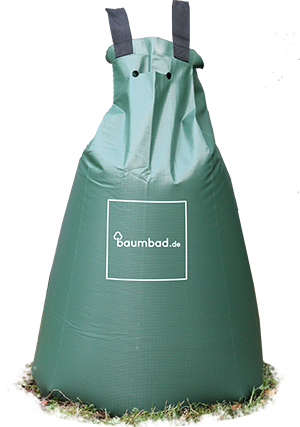
Irrigation bags Especially in the case of young trees, this can be a way to slowly release larger amounts of water into the soil.
- Trees & climate protection
- Tree knowledge
- casting dictionary
- City tree knowledge
- tree watering bag
- People & Nature
https://baumbad.de/blogs/baumbewaesserungssack/zunehmende-probleme-fur-stadtbaeume
https://baumbad.de/blogs/baumbewaesserungssack/zunehmende-probleme-fur-stadtbaeume
https://baumbad.de/blogs/baumbewaesserungssack/zunehmende-probleme-fur-stadtbaeume
https://baumbad.de/blogs/baumbewaesserungssack/zunehmende-probleme-fur-stadtbaeume
https://baumbad.de/blogs/baumbewaesserungssack/zunehmende-probleme-fur-stadtbaeume
https://baumbad.de/blogs/baumbewaesserungssack/zunehmende-probleme-fur-stadtbaeume
Do you want to know more about trees and climate?
That might interest you


Great idea, easy handling and everything from ordering to delivery.
Michael K.