Your shopping cart is currently empty.
| Subtotal | €0,00 |
| Shipping costs | including VAT, excl. Shipping costs |
| Total | €0,00 |
|---|


04.09.2026
Table of Contents
- When does a tree actually need liquid fertilizer?
- How can you recognize a nutrient deficiency in a tree?
- The danger: Fertilizing during dry periods
- Mineral or organic liquid fertilizer?
- Why soil life is so important for trees
- Vital bath: Regeneration for weakened trees
- The power duo: Vital bath and worm compost
- Conclusion: First determine the cause, then fertilize.
Trees need nutrients, water, and healthy soil to remain vital in the long term. Therefore, when a tree appears weakened, develops yellow leaves, or shows little growth, many people resort to liquid fertilizer.
But does liquid fertilizer really help? And does every weakened tree need additional nutrients?
This article explains when liquid fertilizer can be useful, what the differences are, and why soil health is often more important than simply supplying nutrients. You'll also find basic information here about... Fertilizing trees.
Key facts at a glance
- Liquid fertilizer can provide trees with targeted nutrients as needed.
- Not every tree problem is caused by nutrient deficiency. Drought stress, soil compaction, and root damage can also be causes of weakened trees.
- Mineral and organic liquid fertilizers differ in their composition and mode of action.
- A healthy soil life contributes to nutrient supply and good growth conditions.
- Irrigation, soil conditions and nutrient supply should always be considered together.
When does a tree actually need liquid fertilizer?
Liquid fertilizer can be beneficial if a tree has an increased need for nutrients or is deficient in nutrients. However, a weakened tree does not automatically require additional nutrients. Liquid fertilizer can be helpful in the following cases:
- proven or probable nutrient deficiency
- nutrient-poor locations
- certain deficiency symptoms
- increased nutrient requirements
In cases of drought stress, root damage, soil compaction or after construction work Instead, the underlying cause should be treated first.
One advantage of many liquid fertilizers is that nutrients can be available relatively quickly. However, how quickly they can be absorbed by the plant depends on the composition of the fertilizer and the soil conditions.
How can you recognize a nutrient deficiency in a tree?
Yellow or unusually pale leaves, small leaves, and weak growth can indicate a Nutritional deficiency Changes in leaf color or premature leaf drop can also be indicators. However, such symptoms are not definitive and do not automatically mean that the tree is lacking nutrients.
Similar symptoms can be caused by drought, waterlogging, soil compaction, or damaged roots, for example. Also, the Soil pH plays a role: If it is unfavorable for the respective tree species, certain nutrients may be less available to the roots, even though they are present in the soil.
Before applying large quantities of fertilizer, it is therefore worthwhile to take a closer look at the site conditions. In the case of persistent or unclear problems, a soil analysis can provide information about the pH value and nutrient supply. For valuable trees or significant damage, a professional assessment may also be advisable.
The danger: Fertilizing during dry periods
A common mistake is to over-fertilize a weakened tree during a dry period.
When the soil is severely dried out, the roots can only absorb nutrients to a limited extent. With mineral fertilizers, a high salt concentration can further stress the sensitive fine roots.
Therefore, the first step is to thoroughly water a tree suffering from drought stress. Only once the tree is adequately watered should you consider whether additional fertilization is even necessary. Slow and deep watering is particularly helpful in this case, ensuring the water reaches the root zone.
Mineral or organic liquid fertilizer?
Not all liquid fertilizers work the same way.
Mineral liquid fertilizers
Mineral products usually contain nutrients in a directly soluble form.
Advantages:
- fast action
- targeted nutrient supply
- simple application
Disadvantages:
- They do not promote humus formation
- They hardly support soil life
- increased risk of over-fertilization
- no improvement in soil structure
Organic liquid fertilizers
Organic liquid fertilizers are based on natural raw materials and have a stronger effect through biological processes in the soil.
Advantages:
- Nutrient supply from organic raw materials
- can support biological processes in the soil
- partially slower nutrient release
- Depending on the product, there is a lower risk of high salt concentrations.
Organic products often offer particular benefits for trees that are weakened over the long term, as they support not only the plant but also the soil. You can find more information in the article. organic fertilizer vs. mineral fertilizer. Why soil life is so important for trees
A complex network of microorganisms, fungi, and soil organisms operates underground. These organisms perform important tasks:
- Making nutrients available
- Build up humus
- storing water
- Wurzelwachstum fordern
- Break down pollutants
If this soil life is disrupted, even sufficient nutrients can be used less effectively by the roots.
Vital bath: Regeneration for weakened trees
For many damaged trees, simply applying nutrients is not enough. After drought stress, soil compaction, transplant shock, or construction site damage, the entire biological balance in the root zone is often disrupted.
Vitalbad's plant-based formula was developed to biologically support depleted soils and promote natural regeneration processes. Vitalbad provides:
- plant-available nutrients
- humic acids
- enzymes
- natural micronutrients
- Food for microorganisms
This supports soil life and root space, creating the conditions for better water and nutrient absorption.
The power duo: Vital bath and worm compost
The combination of tree bath is particularly interesting. Worm compost and Vital bathBoth products are liquid and easy to apply, but they fulfill different tasks.
Baumbad worm compost focuses primarily on the long-term development of healthy soil. It provides valuable humus, microorganisms, and organic compounds that promote soil life and can sustainably improve soil quality.
Vitalbad, on the other hand, was specifically developed to biologically support weakened trees and degraded soils. The herbal formula provides nourishment for microorganisms, supports biological activity in the root zone, and promotes natural regeneration processes.
Simply put:
- Worm compost supports the long-term development of living soil.
- Vital bath supports the activation and regeneration of weakened root areas.
Therefore, both products can be usefully combined, especially after drought stress, transplanting or soil compaction.
Conclusion: First determine the cause, then fertilize.
Liquid fertilizer can be a useful supplement if a tree actually needs additional nutrients. However, a weakened tree does not automatically suffer from nutrient deficiency.
Drought stress, root damage, soil compaction, or unfavorable site conditions can cause similar symptoms. Therefore, the first step should be to determine what the tree is lacking. Adequate water supply and good conditions in the root zone are essential. Liquid fertilizer can supplement these measures if the tree has a corresponding nutrient requirement, but it cannot replace them.
Natural fertilization and activation of soil life
The power of the soil

Offer -35%
Baumbad liquid fertilizer made from worm compost, 3 liters - NPK 1-1-1
liquid fertilizer
€24,99 €38,97

Offer -23%
Baumbad Liquid Fertilizer Vermicompost 1 Liter / Worm Compost Tree Fertilizer NPK 1-1-1
liquid fertilizer
€9,99 €12,99

Offer -11%
Baumbad Premium Liquid Fertilizer made from worm compost, 5 liters - NPK 1-1-1
liquid fertilizer
€39,99 €44,99

Offer -29%
Baumbad Liquid Fertilizer - Vital Bath - Regeneration for Damaged Trees 5 Liter
liquid fertilizer
€39,99 €56,49

Offer -34%
Baumbad Liquid Fertilizer - Vital Bath - Regeneration for Damaged Trees 3 Liter
liquid fertilizer
€24,99 €37,99

Offer -25%
Baumbad Liquid Fertilizer - Vital Bath - Regeneration for Damaged Trees 1 Liter
liquid fertilizer
€9,99 €13,49
Tips, knowledge and practical advice for strong trees
Discover more posts
Trees need nutrients to grow healthily. In many gardens or cities, these nutrients are lacking in the soil, for example, because leaves are removed or the soil is heavily used. Appropriate fertilization can help improve the soil and support tree growth. However, it's important not to fertilize simply "on a hunch," as some soils already contain sufficient nutrients.
Organic fertilizers like compost or worm castings work more slowly, but improve the soil in the long term and promote soil life. Mineral fertilizers work faster, but usually only provide individual nutrients. For many trees, organic fertilization is the more sustainable solution in the long run.
Yes, that can be very helpful. A soil sample can determine which nutrients are present in the soil and which are lacking. The pH value is also measured. This allows you to fertilize the tree precisely and avoid over-fertilizing. A simple soil analysis usually only costs around [price missing]. €20–40.
A nutrient deficiency can manifest itself, for example, through yellow or pale leaves, weak growth or few flowers show. However, similar symptoms can also be caused by drought or compacted soil These problems arise. Therefore, you should always check first whether the tree is getting enough water.
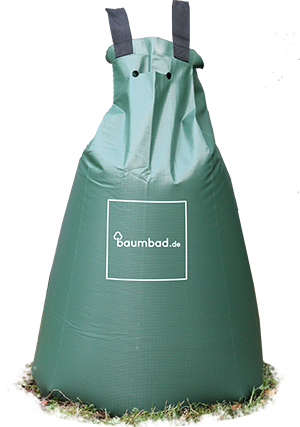
Yes, that's possible. Irrigation bags release water slowly into the soil. When liquid fertilizer is mixed with water, it reaches the root zone evenly. This way, a large portion of the soil around the tree comes into contact with the nutrient solution.
The best time to fertilize is usually in spring and early summerFertilizing is best when the tree is growing and producing new leaves. During this phase, the tree can absorb nutrients particularly well. Very late fertilization in autumn is usually not advisable.
The soil is home to many microorganisms, such as bacteria, fungi, and earthworms. They break down organic matter and make nutrients available to plants. Active soil life therefore helps trees absorb water and nutrients more effectively. Organic fertilizers can support this soil life.
Great idea, easy handling and everything from ordering to delivery.
Michael K.