Your shopping cart is currently empty.
| Subtotal | €0,00 |
| Shipping costs | including VAT, excl. Shipping costs |
| Total | €0,00 |
|---|


27.06.2026
Water bags, also known as tree watering bags, allow larger quantities of water to be slowly released into the ground over several hours. The watering bags are attached to the tree, filled with water, and then release it drop by drop through small openings on their underside.
This article explains how water bags work, which trees they are suitable for, and what you should pay attention to when using them.
Table of Contents
- What is a tree watering bag?
- How does an irrigation bag work?
- Which trees are suitable for water bags?
- How do you properly attach an irrigation bag?
- How much water fits in an irrigation bag?
- How long does it take to empty an irrigation bag?
- How often should a water bag be filled?
- Water bags for older trees
- Connect several water bags together
- Advantages of water bags
- Water bag, watering ring or drip irrigation?
- Which watering bag is the right one?
- Proper care of the irrigation bag
- Frequently asked questions about water bags
What is a tree watering bag?
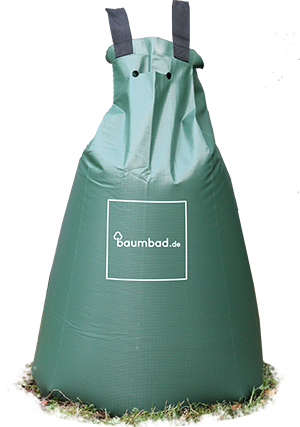
A water bag is a bag that can be filled with water and is used to water trees. It is usually placed around the trunk of a young tree and closed with a zipper. Alternatively, it can be placed on a stake in the root area of older trees.
There are small openings on the underside through which the water slowly leaks out. Depending on the model, it takes several hours for the water bag to empty completely.
This type of tree watering goes by various names. Besides "water bag," the terms "irrigation bag," "watering pouch," "tree watering bag," or "tree watering pouch" are frequently used. They all refer to the same basic principle: a larger quantity of water is stored and then released drop by drop onto the ground.
How does an irrigation bag work?
The application is simple: The watering bag is attached to the tree, sealed and then filled with water.
The water doesn't all flow out of the bag at once. Small openings ensure that it gradually seeps onto the ground. The watering bag thus works on a similar principle to other forms of drip irrigation.
Slow water release can be particularly advantageous in dry or compacted soils. If a large quantity of water is applied very quickly, some of it can run off the surface. Slower water release gives the soil more time to absorb the water.
The point is not that the water needs to penetrate as deep into the soil as possible. What is crucial is that the soil layer penetrated by the roots is sufficiently moistened. This is where the fine roots are located, through which the tree absorbs a large portion of the water it needs.
You can learn more about the principle of slow water release in our article. Drip irrigation for trees.
Which trees are suitable for water bags?
Irrigation bags are particularly well-suited for young and newly planted trees. After planting, a large portion of the roots initially remains within the area of the original root ball. Over the following years, the tree must develop new roots and establish itself in the surrounding soil. Adequate water supply is especially important during this phase.
When the watering bag is placed around the trunk, the water seeps into the soil around the young tree. This makes watering easy to organize. Typical applications include:
- newly planted trees in the garden
- Young trees along roads and in public areas
- fruit trees
- Trees on company premises and larger properties
- Tree plantings by cities and municipalities
- Trees as part of watering and tree sponsorships
For older and more established trees, however, the application should be adapted. Their water-absorbing fine roots are not only located directly at the trunk, but are distributed over a larger area of soil. We will discuss this in more detail below.
How do you properly attach an irrigation bag?
Here are the most important steps:
1. Place the irrigation bag around the trunk or a stake: Place the open bag around the tree trunk and close the zipper.
2. First, add some water: First, only partially fill the bag. Then, briefly lift it by the loops. This allows the bottom of the bag to expand, making it easier for the water to drain out of the designated openings later.
3. Fill the watering bag completely: Then you can fill the bag with water up to the intended fill level.
The water will now be slowly released to the ground over several hours.
It is important that the outlet openings are not blocked by dirt or debris. If a bag empties unusually slowly or not at all, you should therefore check the openings first.
How much water fits in an irrigation bag?
Irrigation bags are available in different capacities. tree bath watering bag They are available, for example, with a capacity of 75 or 100 liters. With suitable models, several bags can be connected together.
The capacity of the bag should not be equated with a tree's actual water requirements. How much water a tree needs depends on several factors, including:
Tree species, size and age of the tree, soil type and structure, location, amount of precipitation, temperature and duration of a dry period influence the water requirement.
For example, a large, established tree may require significantly more water than a newly planted sapling.
You can find detailed information in our guide. Water trees properly.
How long does it take to empty an irrigation bag?
An irrigation bag doesn't release the water it contains immediately, but gradually over several hours. The actual emptying time depends on the specific model and the conditions of use. The type of ground and the condition of the drainage holes can also play a role.
The slow release has a practical advantage: you don't have to stay by the tree with a watering can or garden hose for an extended period. The bag fills up and then releases the water automatically.
This can be particularly useful if several trees need to be watered one after the other.
How often should a water bag be filled?
A general recommendation like "once a week" or "twice a week" is not suitable for every tree and every location. How often watering is necessary depends primarily on the tree's age, soil type, location, weather, and rainfall.
Generally speaking, it's often more beneficial for trees to thoroughly moisten the soil with a sufficient amount of water, rather than watering them only in small amounts daily. Very frequent, shallow watering may only moisten the top few centimeters of soil.
Therefore, also check the actual soil moisture. A short rain shower, for example, does not automatically mean that enough water has reached the root zone.
You should be especially careful with newly planted trees and during prolonged hot and dry periods.
Can water bags also be used for older trees?
In principle, watering bags can also be used for older trees. However, the position of the water bag is particularly important.
- When planting a new tree, it's beneficial to deliver water to the area around the root ball and developing roots. Therefore, the bag can be placed directly around the trunk.
- The root distribution of an older tree is different. Many of the fine roots, crucial for water absorption, are not located directly at the trunk but are distributed throughout the soil. One solution is to place a watering bag on a sturdy stake in the root zone. This allows for more targeted watering. For large trees, multiple watering points can also be beneficial. The positions of the bags can be changed between watering sessions to avoid repeatedly watering the same small area.
You can learn more about where trees absorb water in our article about Fine roots of trees.
Can multiple water bags be connected together?
Many watering bags allow you to connect multiple bags together using their zippers. This can be practical, for example, when dealing with plants with a larger trunk circumference. At the same time, this increases the amount of water that can be delivered in a single watering session.
Whether this is advisable, however, depends on the tree. For a large, older tree, attaching more and more watering bags directly around the trunk is not automatically the best solution.
In this case, the location of the relevant root area is more important. Therefore, several separate watering points may be more suitable than a large amount of water applied directly to the trunk.
What are the advantages of water bags for trees?
The main advantage of an irrigation bag lies in the combination of a large storage capacity and slow water release.
The bag can be filled relatively quickly and then releases the water automatically over a longer period. This reduces the time required for actual watering.
At the same time, the known capacity makes it possible to track how much water has been supplied. This simplifies the planning of watering sessions, especially for larger stands of trees.
Other advantages include ease of use, reusability, and the fact that no permanently installed irrigation system is required.
We have discussed the various advantages and applications in detail in the article. Why the use of tree watering bags is worthwhile for your convenience.
Water bag, watering ring or drip irrigation?
A watering bag isn't automatically the best watering method for every situation. It's particularly easy to use for individual young trees. However, for hedges, flower beds, or many closely spaced plants, a permanently installed drip irrigation system might be more suitable.
Another option is watering rings. They lie flat on the ground and can therefore be used, for example, for shrubs, certain conifers, or in situations where a classic watering bag cannot be properly attached to the trunk.
Watering cans and garden hoses remain sensible options for watering trees. The crucial factors are not so much the specific tool used, but rather the appropriate amount of water, the correct watering area, and sufficient soil moisture.
If you're still unsure which method is suitable for your tree, you can find more information in our article. Watering trees: a comparison of watering bags, watering cans, watering rims or drip irrigation? a detailed comparison.
Which watering bag is the right one?
Watering bags differ in material, capacity, construction, and shape, among other things. At baumbad, for example, you'll find watering bags made of PVC and PE with various capacities and a flat watering ring.
Which product is best depends on which plants you want to water and how you intend to use the bag.
We explain the differences between the models in detail in our article. PE or PVC – An overview of the baumbad product range.
You can find more information in this video:
How do I care for an irrigation bag?
To ensure your watering bag lasts as long as possible, you should check it regularly and keep it clean. Pay particular attention to making sure the small openings for water release are not blocked. Dirt and debris can cause the bag to empty much more slowly or unevenly.
If you won't be using the bag for an extended period, it should be emptied, cleaned, and stored in a dry place. You can find more information in the article. Store tree watering bags and watering rings over the winter.
Damage doesn't necessarily mean that an irrigation bag has to be thrown away. Depending on the material and type of damage, minor defects can be repaired.
You will also find detailed instructions on how to repair tree bags as well as tips on the care and longer use of watering bags.
Frequently asked questions about water bags for trees
Can an irrigation bag remain permanently on the tree?
A water bag can be reused repeatedly during the watering season. Nevertheless, it's advisable to remove it regularly and check both the trunk and the bag. This allows you to detect moisture, dirt, or potential damage early on.
Outside of the irrigation season, you should clean the bag, dry it and store it in a protected place.
Can I connect multiple watering bags?
With suitable models, several bags can be connected to each other via the zippers. This can be helpful for larger trunk circumferences or to provide a larger quantity of water.
Does an irrigation bag need to be placed directly against the tree trunk?
No. For young and newly planted trees, the watering bag can be placed directly around the trunk, as a large portion of the roots are initially still within the root ball. This isn't always practical for older trees. Their water-absorbing fine roots are spread over a larger area of soil. In this case, the watering bag can be placed, for example, on a stake in the root zone. For large trees, multiple watering points may also be advisable.
Further information
Instructions, questions and answers can be found in the article. Instructions for using tree watering bags.
In addition, we recommend the article 10 mistakes with watering bags - and how to avoid them.
- tree watering bag
- Tree knowledge
- tree care
- casting dictionary
- City tree knowledge
- Trees & climate protection
https://baumbad.de/blogs/baumbewaesserungssack/wassersaecke-fuer-baeume
https://baumbad.de/blogs/baumbewaesserungssack/wassersaecke-fuer-baeume
https://baumbad.de/blogs/baumbewaesserungssack/wassersaecke-fuer-baeume
https://baumbad.de/blogs/baumbewaesserungssack/wassersaecke-fuer-baeume
https://baumbad.de/blogs/baumbewaesserungssack/wassersaecke-fuer-baeume
https://baumbad.de/blogs/baumbewaesserungssack/wassersaecke-fuer-baeume
Do you want more tree knowledge?
That might interest you

How to properly water city trees: Why they are important...
Urban trees are the green lungs of our cities and ensure an optimal climate. But this is becoming increasingly difficult...

Water fruit trees properly
Fruit trees warm our hearts. We love their blossoms and rejoice in their beauty...
Great idea, easy handling and everything from ordering to delivery.
Michael K.